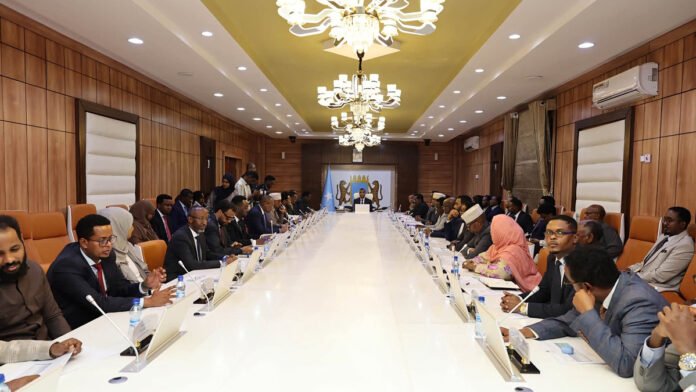
MOGADISHU, Nov. 24 (Somalia Tribune) – Somalia’s Council of Ministers has approved proposed amendments to the country’s national election law and legislation governing political associations and political parties, in a move the government says is aimed at aligning existing laws with the country’s newly approved constitution.
The amendments were approved during an extraordinary cabinet meeting held in Mogadishu on Tuesday, November 24, chaired by Prime Minister Hamza Abdi Barre, according to a government statement.
The proposed changes cover 23 articles of the national election law and eight articles of the law governing political associations and parties.
Under the proposed electoral framework, citizens would directly elect local council members, representatives of federal member state legislatures and members of both houses of the Federal Parliament.
However, positions ranging from district chairpersons to the president of Somalia would be filled through elections conducted by the respective elected councils and legislative bodies, according to the amendments outlined by the government.
The changes also introduce new requirements for political organisations seeking recognition as national parties.
Under the proposed amendments, a political association that secures at least 10% of the votes in a federal election would qualify for recognition as a national political party.
The cabinet also agreed that political organisations would submit their parliamentary candidates through a closed-list electoral system, commonly known as the closed-list method.
The system requires political parties to present ranked lists of candidates, with voters choosing a party rather than selecting individual candidates directly, subject to the applicable electoral rules.
In another decision, ministers agreed that the Independent National Electoral and Boundaries Commission would have the authority to develop technical arrangements to simplify voter registration and voting procedures.
The government said the measure is intended to facilitate citizens’ participation in elections, in line with constitutional provisions requiring authorities to make the voting process more accessible.
The proposed amendments come as Somalia continues efforts to establish an electoral framework consistent with its constitutional arrangements and political transition.
The cabinet said the changes were necessary because the existing election and political party laws had been approved before the adoption of the new constitution and therefore required revision to ensure consistency with the constitutional framework.
Separately, the Council of Ministers approved an agreement between the Federal Government of Somalia and the United Nations concerning the establishment of an office for the UN Office of the High Commissioner for Human Rights (OHCHR) in Somalia.
The agreement, presented by the Ministry of Family and Human Rights Development, is intended to provide diplomatic privileges and immunities for OHCHR personnel operating in the country.
The office is expected to work with various Somali government institutions and provide support and cooperation on human rights matters.
The cabinet’s approval of the proposed legal amendments marks another step in the government’s efforts to revise the country’s electoral and political party framework. However, the proposals will need to go through the applicable legislative procedures before becoming law.