
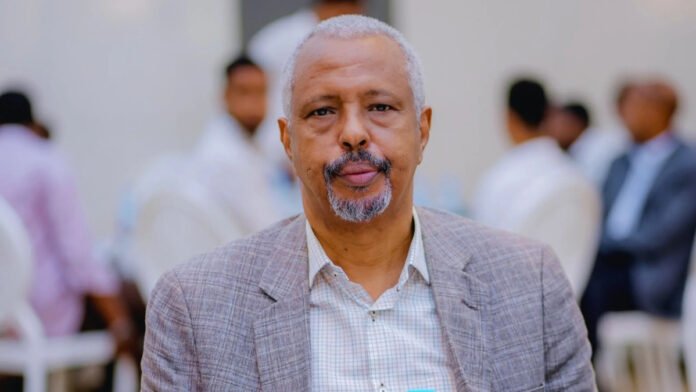
CAIRO, Egypt – Former Hirshabelle State President Ali Abdullahi Osoble has died in Egypt after a prolonged illness, his family confirmed on Sunday evening, marking the loss of one of the key figures involved in the establishment of the regional administration.
Osoble, who had been receiving medical treatment at a hospital in Egypt in recent weeks, was among the founding political figures of Hirshabelle, the federal member state formed in 2016 through the merger of Hiiraan and Middle Shabelle regions.
He made history on October 17, 2016, when he was elected the first president of Hirshabelle, becoming the leader of the youngest federal member state established under Somalia’s federal system.
Until his death, Osoble served as chairman of the Hawadle Community Political Council, maintaining an influential role in regional politics even after leaving the presidency.
Political Position and Hirshabelle’s Leadership Election
In September 2026, Osoble led a delegation to Mogadishu for talks with incumbent Hirshabelle President Ali Abdullahi Hussein Guudlaawe, who had served as his deputy a decade earlier.
The political council led by Osoble publicly backed Guudlaawe’s bid for a second term and supported former Hiiraan governor Abdifatah Hassan Afrah for the vice-presidency.
Osoble argued that the political alliance could help bring divided communities together and strengthen the regional administration.
During the meeting, he said senior political positions should be determined by competence, community support and the ability to deliver development, rather than being based solely on clan claims.
His position differed from that of some Hawadle traditional elders in Hiiraan, who demanded that the presidency be allocated to their community and called for a political agreement before elections proceeded.
Despite the disagreement, Hirshabelle lawmakers re-elected Guudlaawe on October 24 for another five-year term, while Afrah secured the vice-presidency.
The outcome was rejected by some traditional elders in Beledweyne, who called for broader consultations on Hiiraan’s political representation.
Role in the Formation of Hirshabelle
Osoble’s political legacy was closely linked to the creation of Hirshabelle, a process that faced resistance from some traditional leaders in Hiiraan over concerns about political representation and power-sharing.
Following the formation process, traditional elders selected a regional parliament that convened in Jowhar in October 2016.
Osoble won the presidential election with 61 votes, defeating Mohamed Abdi Waare, who received 36 votes. Guudlaawe was subsequently elected vice-president.
During his administration, Osoble oversaw the establishment of key regional institutions, including the selection of Hirshabelle’s senators and members of the federal parliament.
In February 2017, he appointed the administration’s first cabinet, comprising 52 ministers, following negotiations over clan representation.
However, his presidency was short-lived. On August 14, 2017, regional lawmakers removed him through a vote of no confidence, accusing his administration of poor performance and insufficient consultation.
Osoble disputed the legality of his removal, arguing that the process violated the regional administration’s constitution. He was succeeded by Mohamed Abdi Waare, before Guudlaawe assumed leadership in 2020.
Early Life and Political Career
Born in Mogadishu on June 15, 1961, Osoble came from a family with a history of involvement in Somali politics.
His father, Abdullahi Osoble Siad, served as minister of posts and telecommunications under the government of former president Mohamed Siad Barre. His maternal grandfather, Ahmed Gelle, also served as justice minister before the military takeover.
Osoble studied in the United States, graduating with a bachelor’s degree in agricultural economics from Sam Houston State University in Texas.
He began his professional career at the Somali Development Bank before moving into humanitarian work with Oxfam-Quebec in Beledweyne and later serving as the organisation’s Somalia representative in Nairobi.
He entered national politics in 2004, joining Somalia’s Transitional Federal Parliament, where he served until 2012.
In 2005, he was appointed education minister under Prime Minister Ali Mohamed Gedi. He later served as minister of planning and economic development following a cabinet reshuffle.
His death marks the end of a political career that spanned national government service and the early formation of one of Somalia’s federal member states.

